

Updated from original publication in 2021.
My Physical Challenge – Arnold Chiari Malformation
The car in front of us suddenly stopped, making my husband stomp on the brakes and my head whip back. Traffic crawled through the congested construction zone, then soon returned to sixty miles an hour. Minutes later, red brake lights flashed again. We came to an abrupt halt, and my head bounced off the headrest. I closed my eyes and bent forward to relieve the pain.
Traffic raced back to the speed limit, and for a third time in a fifteen-mile stretch of freeway, we hit gridlock. My husband slammed on the brakes to avoid an accident. I hurt from the back of my neck, up over the top, and down to my eyes. The pain from the Chiari Migraine made it hard to look up, move my head, or even think.
We stopped for a break at a fast-food restaurant, and I could barely unfold my legs to get out of the car. When I tried to walk, I got dizzy and lost my balance. The next morning, the pain had not left, and every step I took pounded in the back of my head.
The driving incident began a series of migraines caused by my Arnold Chiari Malformation. My recurrent headaches with radiating pain in my neck, across my shoulders, and down my spine were part of my daily life. I changed my activities and routine to avoid many of the actions I knew caused a headache, but at times, merely turning my head brought on a migraine.
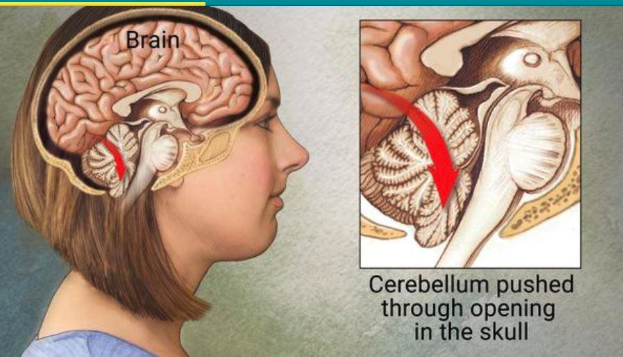
What is an Arnold-Chiari Malformation
Chiari Malformations, pronounced Kee-are-ee, are structural defects in the base of the skull and brain tissue present at birth. They affect people of all ages, from birth through adulthood, and often don’t show signs until ages 20-40 or later, as in my case.
Chiari Malformations occur when part of the cerebellum pushes through an opening in the skull into the upper spinal canal, blocking the flow of cerebrospinal fluid. This blockage creates downward pressure that pushes the lower portion of the brain onto the brain stem, causing various symptoms throughout the body.
Although not considered a fatal condition, it can cause permanent nerve damage if not treated either medically or surgically by a professional familiar with Chiari.
Symptoms
Some people with Chiari Malformations have no symptoms. Others may have symptoms such as:
- Pain in the lower back of the head and the neck
- Dizziness
- Muscle weakness
- Numbness
- Vision problems
- Headaches
- Problems with balance and coordination
- Difficulty swallowing
- Nausea
- Ringing or buzzing in the ears
- Insomnia
- Depression
- Problems with hand coordination and fine motor skills
Doctors often use an MRI to diagnose Chiari Malformation. If the Chiari causes no symptoms and doesn’t interfere with daily activities, no treatment is necessary. Others may need medications to manage the pain. Surgery is the only treatment that can correct functional defects and stop the progression of damage to the central nervous system.
My Diagnosis
Sharing my personal journey, I was diagnosed after I couldn’t move my right arm or walk without dizziness and losing balance. After treatment, I learned to control my symptoms for over ten years until the ‘car accident,’ when my symptoms worsened. My neurosurgeon recently requested new MRI images and now recommends surgery.
One study shows decompression surgery reduces headaches by 75%, neurological symptoms by 88%, and daily life impact by 75%, highlighting the potential benefits of treatment.
Chiari Malformation is a lifelong condition, but with medical treatment and surgery as needed, symptoms can be controlled or reduced. I am preparing for surgery and remain hopeful for a positive outcome, encouraging others to consider treatment options for a better life.
Update
In 2018, I underwent Chiari Malformation decompression surgery. Recovery took about a year, but I regained my life. Now, eight years later, I know my triggers and live a normal life, with infrequent headaches and brief dizziness. I’m grateful I chose surgery and want others to see the hope it offers.
If you or someone you know has a Chair Malformation and wants someone to talk to about it, please get in touch with me. This condition is still rare, but there is hope for a much more normal life if surgery is an option for you.
Sources:
https://www.webmd.com/brain/chiari-malformation-symptoms-types-treatment#1
https://www.ncbi.nlm.nih.gov/pubmed/19519678
Joyce Zook is a Professional Christian Life Coach with ICCI, working with women online and by phone. She is a wife, mom, grandma, author, and speaker from East Texas. Joyce manages symptoms of an Arnold Chiari Malformation. Connect with her on Facebook, Instagram, YouTube, and her website. JoyceZook.com